
 By Roy Nuhn
Gulliver’s Travels has been a part of our literary and cultural history for close to 300 years. First published in 1726, the novel quickly became a favorite with children. It has remained so for countless generations, being considered almost a fairy tale during the last 150 years. Collectors have long sought books and memorabilia inspired by the 18th-century tale of a ship’s surgeon’s fantastic South Seas adventure.
Travels into Several Remote Nations of the World, as the book was originally titled, was a biting political and social satire. An overnight success, Gulliver’s Travels was initially enjoyed by people of all ages. From parish pastor and royal cabinet minister to wealthy businessman and college student, everyone read and devoured Swift’s powerful commentary on the foibles of the ruling class. Great work that it was, though, the novel soon became outdated. But it has flourished ever since as a juvenile literature classic.
The saga of Gulliver among the tiny people of Lilliput is but one, albeit the most famous, of four parts of the novel. Gulliver is later left ashore on Brobdingnag, a land of giants; then visits the flying island of Laputa, where men of science, philosophers and historians are lampooned; and, finally, he goes to the country of the Houyhnhnms, a land inhabited by noble, rational horses and by the Yahoos, beasts in the form of people but whose human vices shock and disgust Gulliver.
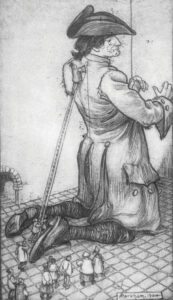 Gulliver’s Travels, one of Western civilization’s great literary works, was written by Jonathan Swift (1667-1745). Swift was a clergyman and a political activist for most of his life. He wrote countless political pamphlets and tracts, and edited a Tory newspaper.
Since Gulliver’s Travels’ first printing in 1726, the adventure fable has endured as a staple for both English and American publishers. In this country special small sized, abridged editions for children of all ages began appearing toward the middle of the 19th century. Almost always, however, only the story of Gulliver in Lilliput, the most adaptable part of the novel for children, was told.
One of the earliest of these books, sometime in the l850s, was by McLoughlin Company as part of its “Aunt Fanny Fairy Tales” series. Later, when the firm became the more familiar McLoughlin Bros., numerous printings continued to be marketed throughout the balance of the century.
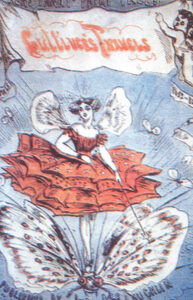
From the beginning, Gulliver’s Travels books and booklets by all publishers of children’s literature were illustrated, with hand coloring being used in the earliest editions. After the Civil War, the perfection of color lithography began a tidal wave of beautifully drawn and printed books for young people, including those of Gulliver’s Travels. An 1889 edition, for instance, was illustrated by Arthur Rackham, another in 1900.
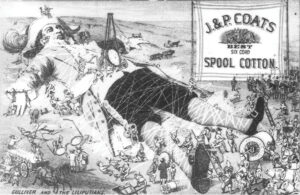
 Gulliver in the land of the Lilliputians was an image that beckoned certain manufacturers, especially makers of sewing threads. J. & P. Coats, the largest user of the idea, issued several trade cards in the late l880s and l890s ballyhooing the strength of their product. One, “GJ.1lliver and the Lilliputians,” portrays the ship-wrecked man securely tied down by the company’s thread after being washed ashore and falling asleep. Another trade card scene is of Gulliver dragging Blefusu’s invasion fleet of 50 men-of-war ashore with lengths of Coats Spool Cotton tied to each boat.
Pictorial versions of the story in magazines, anthologies and educational books were plentiful during the first decades of the 20th century. The Book of Knowledge (The Grolier Society, 1912), an illustrated child’s encyclopedia set, is a good example. It offered several excellent illustrations in their section on Gulliver’s Travels.
In the 1920s and 1930s, leading publishers of juvenile literature and paper novelties, such as Whitman and Saalfield, published a few booklets, but interest in the classic tale declined.
In the early 1930s, Walt Disney’s Gulliver Mickey, a cartoon with Mickey Mouse in the lead role, had its first theatrical run. Rare film memorabilia from this includes one-sheet posters and promotional materials.
A brief revival of fascination with the tale occurred in 1939 when legendary cartoonist Max Fleischer’s animated feature, Gulliver’s Travels, was released. The film premiered in December, 1939 amidst a barrage of publicity. The story centered on the Lilliput episode, which underwent major changes. New characters were added, such as Prince David and Princess Glory of the warring kingd9ms, and Gabby the town crier who first discovers Gulliver. The film did poorly with critics, who panned it, and with audiences, who stayed away. The nearest thing to a winner from it was Gabby, who went on to star in his own cartoon series in 1940 and 1941.
But the full length cartoon movie did result in a considerable amount of souvenirs. Licenses were granted to Saalfield and others to publish all kinds of books and booklets about Fleischer’s rendering of Gulliver’s Travels.
Saalfield put an assortment of different items on store shelves in 1939 and 1940, most of them to an indifferent public. Among their products were illustrated story books in all sizes, a paper doll cut-out booklet, a Big Little Book, and a line of jigsaw puzzles.
In 1939 an advertising booklet was handed out by Macy’ s Department Store (New York City) as a Christmas present for shoppers. The premium with blue and white illustrations and color covers, helped promote the film, and wished customers “A Merry Christmas and a Happy New Year from Macy’s.”
Valentine & Sons, the English postcard publisher who had an American sales office, printed at least two sets of six cards each. One had only scenes from the cartoon and was intended as a souvenir; the other, with similar illustrations, carried different birthday greeting messages and was intended for everyday use. These cards are found with early 1940s postmarks.
The first comic book to feature Gulliver and his wild escapades was Classic Comics (later known as Classics Illustrated) No. 16 (December 1943). Like nearly all Classics Illustrated titles, there were many reprints over the next 30 years. This and other comic book editions were based on the original tale and characters by Swift, not Fleischer’s version.
In January 1945 Dell Publishing Co., under its Junior Treasury label of comic books, sold a Gulliver’s Travels title. These were15¢ sellers and had painted covers. Later, in September 1965, Dell debuted Volume No.1 of a new Gulliver’s series. But this lasted for only two issues.
Later movies inspired little or no merchandise. A musical British-Belgium production, part live-action and part animation, was a flop. A Japanese animated feature, Gulliver’s Travels Beyond the Moon, took the franchise into outer space – and to commercial success.
Having prospered for close to three centuries, Jonathan Swift’s timeless novel seems destined to endure for many more generations to come. And along with such popularity, interest and fascination with Gulliver’s Travels memorabilia and collectibles will continue unabated.










Follow Us