
 By Kathy Honea
Artus Van Briggle traveled to Colorado Springs in March 1899, in search of a cure for his tuberculosis. He was an accomplished artist, and had worked at Rookwood Pottery since he was eighteen years of age. In recognition of his talent, Rookwood Pottery had sent him abroad to study for two years. While there, Artus became acquainted with the dead matte glaze of the Ming dynasty period.
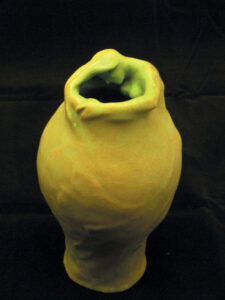
In 1896, Artus returned to the United States and work at Rookwood Pottery. It was in his home in Cincinnati that he created his first “Lorelei” vases, which measure only six and one-half inches in height. Having been produced at home, and not at Rookwood Pottery, these pieces were signed only “A. Van Briggle, 1898.”
Photo: Lorelei, 6 ½” height – one of three know to exist today. Inscribed, “A.Van Briggle 1898”
Suffering from tuberculosis since his return to the U.S., Artus decided it would be prudent to relocate to Colorado Springs, widely touted for its recuperative qualities for the disease. His relocation was with the blessing and continued support of Rookwood Pottery and the pottery’s founder, Maria Longworth. Artus sought respite at Chico Basin Ranch, and it was there that he produced the first design which came to be known as the Van Briggle Chalice, or Toast Cup. From March 1899, throughout the short remaining years of his life until death, Artus often returned to Chico Basin Ranch for rest and recuperation. The W. C. Holmes family took him into their home, and cared for him as one of their family.
The experiences at Chico Basin Ranch influenced his life and affected his future pottery designs. While living with the Holmes family, he interacted with their neighbors, the Southern Ute Native Americans. He had painted earlier Native American designs on Rookwood pottery shapes in a high glaze style. A Rookwood plaque with Native American design by Artus Van Briggle sold in 2006 for more than $60,000.
Artus Van Briggle interacted with the local Native American tribes and captured their every day life on canvas. The talented potter, it seems, was an equally talented painter. Chief Antelope, of the Southern Ute tribe in Colorado, loaned Artus his shield, and it is documented that Artus used the spider design from that shield in several of his later pottery works. He incorporated Native American designs such as their “Whirling Log” pattern, spiders and other motifs in his pottery.
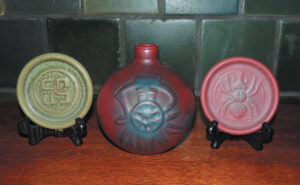 Photo: Native American “Whirling Logs,” Spiders, and other motifs on Van Briggle pottery.
Artus used a design documentation system resembling the one that had been in use at Rookwood Pottery. His first designs were dated 1900; however, very few pottery examples were produced that first year, and those were believed to have been made at Chico Basin Ranch for close friends.
From 1900 until his death in 1904, there have been 247 designs documented from the exhaustive research of Robert Wyman Newton in his Catalogue of Van Briggle Designs. During those years, many of the plain shapes were attributed to Ambrose Schlegel; thought to have been created during periods when Artus was recuperating in Arizona during the winter months at a tuberculosis sanitarium or at Chico Basin Ranch.
In December of 1901, Artus hosted his first exhibit of 300 pieces of pottery at 617 N. Nevada. The invitees were a virtual “who’s who” among local residents, and so fabulously was the pottery received, that all the pieces were sold. On December 1, 1901, the Colorado Springs Gazette stated that within weeks, exhibits were to be assembled and sent to Paris, Madrid, and New York. Van Briggle pottery was marketed in the best jewelry and departments stores in the U.S. and abroad.
In the early years, Artus Van Briggle numbered and dated the pottery pieces. This practice continued fairly consistently until 1920. Early brochures state that Van Briggle pottery was designed in all the colors of the Colorado landscape. Record books of these early years list among the colors produced: several shades of yellows, blues, reds, greens, black, white, gray, purple, browns and combinations of those with one shade sprayed lightly over another.
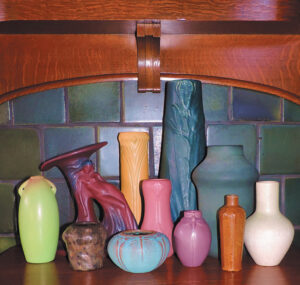 Photo: Van Briggle pottery examples “in all the colors of the Colorado landscape.”
Artus married Anne Gregory in 1902, having become engaged to her while both were studying in Paris. The couple worked together for the next two years. By 1903, Artus was producing tile of various sizes, and the pottery was incorporated. Also that year, one of Artus’ greatest ambitions was fulfilled. Examples of Van Briggle pottery with Artus’ dead matte glaze were accepted for exhibition at the Paris Salon.
Between 1903 and 1904, Rookwood Pottery sent a skilled workman to Colorado Springs, and a few pieces of Van Briggle pottery were produced with metal ornamentation in bronze, copper or silver. Some of these pieces were included in the Van Briggle Pottery exhibit at the Louisiana Purchase Exposition, the 1904 World’s Fair in St. Louis. Van Briggle pottery was given the rare honor of having been allotted display space within three different buildings. The Book of the Fair, by Marshall Evert quotes Henry Neil as saying in 1904, “Van Briggle pottery was described as having blended matte glazes on a close, nearly vitrified stone ware body. The forms and designs of vases and other specialties were plain with occasional decoration in high relief. The matte glazes produced imposing effects, and the blending of the same is artistic. The colors, which were quite numerous, vary from gray, green, red, yellow and blue to blue green.”
Artus, too ill to travel to St. Louis for the events, died on July 4, 1904 in his home at 1712 N. Nevada Ave. in Colorado Springs. Van Briggle Pottery received five medals at the fair, including two gold, two bronze and one silver. We can only hope that he was aware of the great success his short-lived and exhaustive work had achieved.
Anne Van Briggle continued Artus’ work at the first pottery located at 617 N. Nevada Ave., and later built a new pottery on 1125 Glen Ave., dedicating it on December 3, 1908 to the memory and work of Artus. The building is currently owned by Colorado College, and has been placed on the National Register of Historic Places by the United States Department of Interior. The interior and exterior of the building are covered with thousands of decorative tiles in multiple colors, hand-made by Anne Gregory Van Briggle and J. Emma Kinkead. Annually, on a Saturday in September, the Women’s Educational Society of Colorado College opens the building to the public for tours, and as a fundraiser for their scholarship fund. This year, the tour will be held on Saturday, September 12.
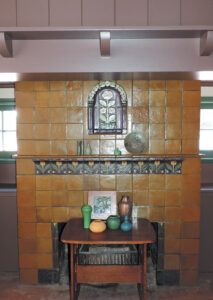 Photo: One of the Van Briggle fireplace tile installations at the Memorial Pottery
The pottery was sold in 1912, and Anne Van Briggle did not return after that time. However; it is important to note that between 1900 and 1912, over 950 designs were created and documented. There remain some missing drawings between the numbered sketches of #1 and #953, but new examples frequently surface. The majority of Van Briggle pottery is dated until approximately 1920, and most have the design number until 1912. It is the early “dated” pieces that remain in high demand and continue to increase in value, while pieces made prior to Artus’ death command the very highest values.
A few pottery managerial changes resulted from 1912 until 1920 when Mr. J.H. Lewis bought the pottery. From 1920 until 1969, Van Briggle was produced primarily in the glaze colors of Persian Rose, Ming Turquoise, and Moonglo White. From the late teens until 1935, a color combination of brown and green, described as “Mountain Crag Brown” was popular. Early literature described the glaze name as depicting the browns and greens found in a mountain crag. Oral history is that the formula for the glaze was lost in the great flood of May 30, 1935, which destroyed the east side of the pottery and washed written records, molds, and pottery downstream.
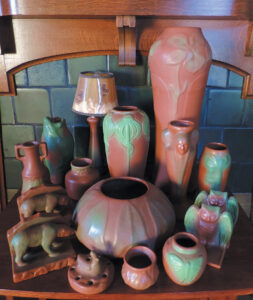 Photo: Van Briggle Mountain Crag Brown glaze examples
In 1970, the pottery was sold to Ken Stevenson, who had worked with Mr. Lewis for several years. It remained in the Stevenson family until closing in 2011. Our greatest source of information for the mid-century years comes from a potter, Fred Wills, who worked at Van Briggle from 1947 until 1988 and resides in Colorado Springs. Fred has a wealth of knowledge and is a valuable resource for anyone studying the history of the pottery. He shared many stories and early photographs for our book, Van Briggle Notes, published in 2011, that chronicles the life of Artus Van Briggle and his pottery from his birth in 1869 to the pottery’s closing in 2011.






Follow Us