
 By Anne Gilbert
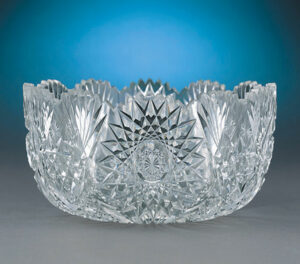
Chances are your grand mother or great grand mother collected some form of cut glass. It was the pride and joy of collectors from 1876, when Brilliant cut glass was introduced at the Philadelphia Centennial. It became the status symbol of its day that lasted till around 1915 when new techniques became popular. Expensive when signed and made by the top American glass companies. These days, when a rare signed piece is offered for sale the price can be in the thousands of dollars. A good example is a brilliant cut glass bowl signed by T.G. Hawkes, offered by dealer M. S. Rau for $1,750. Thomas Gibbons Hawkes was one of the many Irish and English glass makers who immigrated to America in the late 19th century.
The art of cutting glass had its origins in Rome in the first century A.D. They created a clear glass they named “crystal”, that was cut into shallow geometric motifs. By the late 17th century the Germans “rediscovered” the techniques of cutting glass that spread to the glass houses of Bohemia. By the end of the 17th century, English glass makers used a new metal to make glass. However, it wasn’t till the late 18th and early 19th centuries that English and Irish cut and engraved flint glass. It became the new and important method for what came to be known as “brilliant “ cut glass. Early designs used geometric motifs. Some of the finest examples combined several geometric figures. The cutting completely covered the surface of the glass.
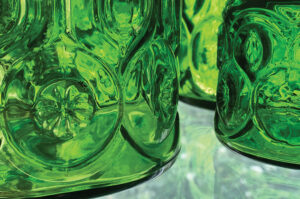 Some unique forms were made that included lamps, tobacco jars and even wig stands.
By 1906 rising production costs and the decline in popularity of the geometric designs resulted in what is known as the “flower Period.” The daisy was and early motif and often combined with fans or hobstars.
CLUES: If you are a beginning collector, reproductions from Europe can be a problem that began in the 1970s. 20th century pieces that were pressed, then cut, are passed off as old and American. Baskets are the most commonly pressed-cut pieces. Carefully examine the edges. They should be sharp. They also lack the outstanding brilliance of the old cut pieces. When “twanged” they don’t resound with a bell tone.
 Do your research before spending too much. Learn to identify signatures.








Follow Us