
 Editor’s Note:
Hard to believe but life is teeming around us. The latest excitement regards the bees. We knew we had bees going in and out of our house near the garage, we just didn’t know how many we had. We called a beekeeper who was more than happy to help re-locate the creatures. It turns out we had between 12,000 and 15,000 bees who have been working hard for over two years to build over 16 combs full of honey. Our beekeeper Chris started at about 8 a.m. in the morning and finished at about 8 p.m. in the evening. Once he had the queen, he felt he could move on. We are sad to see the bees go. We have so many wild flowers on our property probably because of their industriousness. We only hope the remainder of the bees, find a new queen and start a new hive nearby. We are totally fascinated with honey bees and thought you would be, too. Besides being an ancient occupation, collectors should be happy to know there are countless collectibles related to beekeeping.
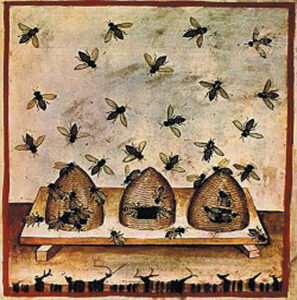
At some point humans began to attempt to domesticate wild bees in artificial hives made from hollow logs, wooden boxes, pottery vessels, and woven straw baskets or “skeps.” Honeybees were kept in Egypt from antiquity. On the walls of the sun temple of Nyuserre Ini from the Fifth Dynasty, before 2422 BC, workers are depicted blowing smoke into hives as they are re-moving honeycombs. Inscriptions detailing the production of honey are found on the tomb of Pabasa from the Twenty-sixth Dynasty (c. 650 BCE), depicting pouring honey in jars and cylindrical hives. Sealed pots of honey were found in the grave goods of pharaohs such as Tutankhamun.
There was an unsuccessful attempt to introduce bees to Mesopotamia in the 8th century BCE by Shamash-resh-ușur, the governor of Mari and Suhu. His ambitious plans were detailed in a stele of 760 BC.
In prehistoric Greece (Crete and Mycenae), there existed a system of high-status apiculture, as can be concluded from the finds of hives, smoking pots, honey extractors and other beekeeping paraphernalia in Knossos. Beekeeping was considered a highly valued industry controlled by beekeeping overseers—owners of gold rings depicting apiculture scenes rather than religious ones as they have been reinterpreted recently, contra Sir Arthur Evans.
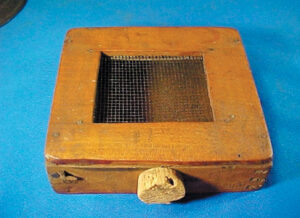 Archaeological finds relating to beekeeping have been discovered at Rehov, a Bronze and Iron Age archaeological site in the Jordan Valley, Israel.
Thirty intact hives, made of straw and unbaked clay, were discovered by archaeologist Amihai Mazar of the Hebrew University of Jerusalem in the ruins of the city, dating from about 900 BC. The hives were found in orderly rows, three high, in a manner that could have ac-commodated around 100 hives, held more than 1 million bees and had a potential annual yield of 500 kilograms of honey and 70 kilograms of beeswax, according to Mazar, and are evidence that an advanced honey industry existed in ancient Israel 3,000 years ago.
In ancient Greece, aspects of the lives of bees and beekeeping are discussed at length by Aristotle. Beekeep-ing was also documented by the Roman writers Virgil, Gaius Julius Hyginus, Varro, and Columella.
Beekeeping has also been practiced in ancient China since antiquity. In the book “Golden Rules of Business Success” written by Fan Li (or Tao Zhu Gong) during the Spring and Autumn Period there are sections describing the art of beekeeping, stressing the importance of the qual-ity of the wooden box used and how this can affect the quality of the honey.
The ancient Maya domesticated a separate species of stingless bee.
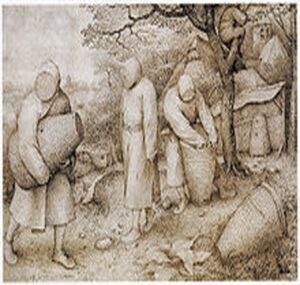 There are more than 20,000 species of wild bees. Many species are solitary e.g., mason bees, leafcutter bees (Megachilidae), carpenter bees and other ground-nesting bees). Many others rear their young in burrows and small colonies (e.g., bumblebees and stingless bees). Some honey bees are wild e.g. the little honeybee (Apis florea), giant honeybee (Apis dorsata) and rock bee (Apis labo-riosa). Beekeeping, or apiculture, is concerned with the practical management of the social species of honey bees, which live in large colonies of up to 100,000 individuals. In Europe and America the species universally man-aged by beekeepers is the Western honey bee (Apis mel-lifera). This species has several sub-species or regional varieties, such as the Italian bee (Apis mellifera ligustica), European dark bee (Apis mellifera mellifera), and the Carniolan honey bee (Apis mellifera carnica). In the tropics, other species of social bees are managed for honey production, including the Asiatic honey bee (Apis cerana).All of the Apis mellifera sub-species are capa ble of inter-breeding and hybridizing. Collecting honey from wild bee colonies is one of the most ancient human activities and is still practiced by aboriginal societies in parts of Africa, Asia, Australia, and South America.
The 19th century saw this revolution in beekeeping practice completed through the perfection of the movable comb hive by the American Lorenzo Lorraine Langstroth. Langstroth was the first person to make practical use of Huber’s earlier discovery that there was a specific spatial measurement between the wax combs, later called the bee space, which bees do not block with wax, but keep as a free passage. Having determined this bee space (between 5 and 8 mm, or 1/4 to 3/8”), Langstroth then designed a series of wooden frames within a rectangular hive box, carefully maintain-ing the correct space be tween succes-sive frames, and found that the bees would build parallel honeycombs in the box without bonding them to each other or to the hive walls. This en-ables the bee-keeper to slide any frame out of the hive for inspection , without harm-ing the bees or the comb, protecting the eggs, larvae and pupae contained within the cells. It also meant that combs containing honey could be gently removed and the honey extracted without destroying the comb. The emptied honey combs could then be returned to the bees intact for re-filling.
More facts about beekeeping: Smoke calms bees; it initiates a feeding response in anticipation of possible hive abandonment due to fire. Smoke also masks alarm pheromones released by guard bees or when bees are squashed in an inspection. The en-suing confusion creates an opportunity for the beekeeper to open the hive and work without triggering a defensive reaction. In addition, when a bee consumes honey the bee’s abdomen distends, supposedly making it difficult to make the necessary flexes to sting, though this has not been test-ed scientifically.
Some beekeepers believe that the more stings a bee-keeper receives, the less irritation each causes, and they consider it important for safety of the beekeeper to be stung a few times a season. Beekeepers have high levels of antibodies (mainly IgG) reacting to the major antigen of bee venom, phospholipase.
The natural beekeeping movement believes that mod-ern beekeeping and agricultural practices, such as crop spraying, hive movement, frequent hive inspections, arti-ficial insemination of queens, routine medication, and sugar water feeding, weaken bee hives.
We must protect the bees. Without them humankind and the earth will perish. Recent headlines indicate tht 42% of honeybee hives in the U.S. died in the past year. According to Dennis vanEngelsdorp of the University of Maryland, “a combination of mites, poor nutrition and pesticides are to blame for the bee deaths.”
Some solutions to this dilemma include regulating the offensive pesticides and designating areas across the country for beekeeping.













Follow Us