
 By Carol Cox
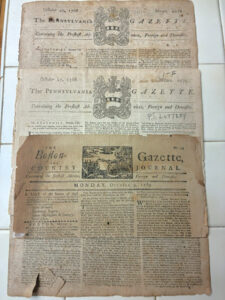
Once in a while, something turns up in Denver that really surprises me. Just recently it happened again. I shouldn’t be surprised. People move across the United States and bring family treasures with them. I suppose what surprises me is these items make it into the open market. You may wonder what turned up – pre-revolutionary war newspapers from Philadelphia and Boston, The Pennsylvania Gazette Numb. 2078 and 2079 dated October 20, 1768 and October 27, 1768 and the Boston and Country Gazette Journal dated October 9, 1769.
So, it made me start thinking about printing in the early days of our Union. A quick google search told me that by 1775 there were 37 independent newspapers and primary media for shaping public opinion, intelligence and the fostering the desire for independence. Most newspapers were only print as illustrations were expensive and hard to come by. Most were printed on a single sheet and folded 4 times to make a complete newspaper. They were expensive to publish and for that reason most were read in coffee houses or other public meeting places.
Most of these publications had the usual items, reprinted articles from England, legal notices, rewards for run away slaves and even lists of merchants that imported goods from England. For history’s sake, it is extremely important when significant events are mentioned like the Boston Tea Party, the French Indian War, or articles by prominent Americans like Benjamin Franklin.
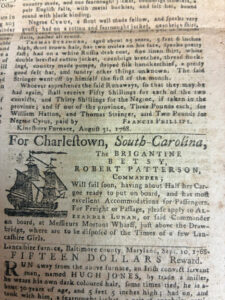 And that is one thing so exciting about these papers. The Pennsylvania Gazette is the oldest newspaper in the United States. It was started in 1728 by Samuel Keimer and purchased by Benjamin Franklin in 1729 and became the most successful paper in America. It was the first newspaper to print the entire contents of the Declaration of Independence on July 10, 1776.
How can a newspaper survive 200 plus years? Newspapers were made of rag paper prior to 1870. Unlike modern pulp paper, rag paper was more durable. Made from cotton or linen fibers instead of wood pulp, it resists yellowing and remains flexible. It was the cost of hand made rag paper that made newspapers such a valuable commodity. The average citizen could not afford a subscription which made coffee houses and meeting halls more important for sharing information.
Today we have electronic media to disperse information, real or fake, good or bad. Most will never be printed and preserved for history. If you are interested in a piece of American history, come out to the Denver Postcard and Paper Show on Friday-Saturday July 17-18, 2026 at the Jefferson County Fairgrounds in Golden, Colorado. There will be postcards, photographs, general ephemera, postal history, Colorado history, railroadiana, travel, and so much more. For more information, see the advertisement in this issue of Mountain States Collector or go to www.denverpostcardshow.com. You can also email Carol Cox at camobley55@gmail.com or call 720-308-1516.







Follow Us