
 By Tom Cotter
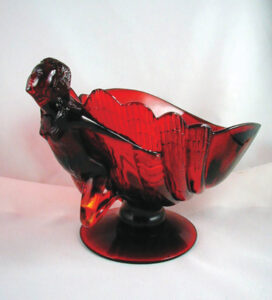
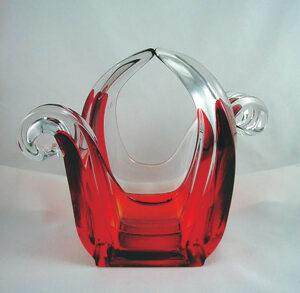
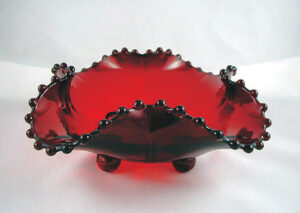
“Red,” I write, “is the color of life. It’s blood, passion, rage… Red is the color of love. Beating hearts and hungry lips. Roses, Valentines, cherries. Red is the color of shame. Crimson cheeks and spilled blood. Broken hearts, opened veins.” ― Mary Hogan, Pretty Face. Whether called Ruby, one of the most prized gems in the world, Carmine, Crimson, Rose, or Scarlet, red evokes personal responses like no other color. So it is not hard to imagine that one of the favorite colors of glass is red. Imagine a white table cloth and napkins, bone china, and vibrant red stemware. Or a vase of scarlet filled with red roses. Nothing else can cause our hearts to beat faster or attract our eyes quicker than something in glorious red. The Rocky Mountain Depression Glass Society celebrates its 40th Ruby Anniversary Array of Color Show and Sale on April 26th and 27th with a special
display of members’ red glass to showcase the event.
To obtain red glass, regardless of chemicals used, the object must be reheated to over 1,000 degrees. This process is called “striking” the glass. The use of more controllable cooling ovens, or lehrs, powered by natural gas, allowed easier reheating of glass to produce red. But there were other issues. While the romantic in us might hold that someone dropped a gold ring into a pot of molten “metal” to make the first ruby glass product, in truth, red glass had been around since Roman times, and thoroughly documented in the 17th century. Gold had to be mixed with aqua regia, or “Royal Water.” No problem; aqua regia sounds like after shave, right? Only it is highly concentrated and corrosive nitro-hydrochloric acid, used to dissolve the gold into solution. And fingers… The expense of even a small amount of gold, the extreme care, and that it had 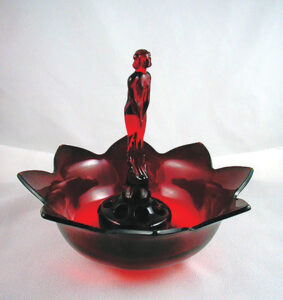 to be reheated to change to red kept “Ruby Gold” glass from being made extensively. Some U.S. companies in the latter 1800s used a mixture with gold to make Cranberry and Ruby flint, or leaded, glass. Dorflinger and New England Glass made some of the most outstanding flashed (coated), cut-to-clear glass. Also, early Amberina and Rubena Verde glass used the gold and reheating process to create multiple colors in a single piece.
By 1850 German/Bohemian flashed glass, created by dipping a clear piece of hot glass with a copper-based layer of glass, became popular in the U.S., and at a cheaper price. Companies began to experiment with other ways to make red glass. Rather than add a red glass coating, U.S. companies found a way to add a silver-based mixture with some reheating in the cooling oven (lehr) that left a ruby stain on the glass. This became a major decoration in the Early American Pattern Glass period of the late 1800s and early 1900s.
While the French patented selenium red glass formulae in the 1800s, Frederick Carder of Steuben Glass often receives credit in the U.S. for glass with selenium and poisonous cadmium sulfide to produce red in a variety of shades, including opaque Rouge Flambe and transparent Selenium Red. Companies like Cambridge, Duncan & Miller, Fenton, Fostoria, Heisey, New Martinsville, Paden City, and others soon followed suit. Styles, forms and decorations abounded!
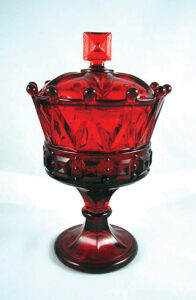 Extension of the a expensive copper-based red formula allowed companies like Anchor Hocking to produce machine-made wares. Although the early Hocking red pieces did contain some gold early on, the formula was limited to a copper and tin formula by 1950. Manhattan, Provincial (Bubble), Roly Poly, and Swirl are among a vast array of Royal Ruby, Anchor Hocking’s vivid red.
The hardest to make glass has been one of the most popular colors for the last several hundred years. Whether Red, Ruby, Selenium, Carmen, Pigeon Blood, or any other label, the various shades and companies pieces are always in demand.









Follow Us