
 By Anne Gilbert
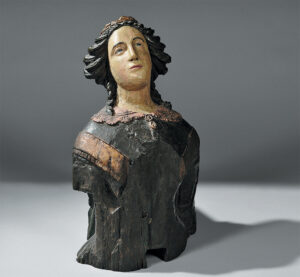
Items related to ships and sailor craftsmanship have never lost their appeal to collectors. This is especially true when items have been made by men at sea from whales teeth and bone into what is known as scrimshaw. The same holds true with ships parts and decorative objects made by 18th and 19th century American craftsmen. Among the rarest examples are ships’ figureheads carved in many forms such as female busts. When they come to auction prices can range from $7,000 up.
While these days some of the best examples are in museums, such as the Mariners’ Museum in Newport News, VA., opportunities come up at Americana auctions held by Skinner Galleries, in Marlborough, MA.
Knowing seafaring terms for items is a must. For example, a billethead, is a scroll form, similar to Ionic and Corinthian capitals and were often used in place of a figurehead on the ships’ prow. They ranged in size from six feet up. Carved rosettes and acanthus leaves were the usual carved decorations. Often they replaced a damaged figurehead. They were used from 1830 to 1880.
 Sailors did their carving with anything from jackknives to sail needles. The lower jaw of a medium-sized whale had approximately 50 teeth from four to ten inches long. After the design was etched, lampblack with a varnish fixative was rubbed over it, then wiped away, leaving the finish picture blacked in. When tinted with color pigments they are even more desirable as miniature works of art.
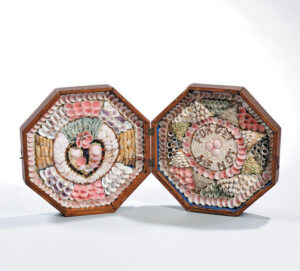
Practical items were also carved from whale bone such as sewing stands, salt dips and kitchen utensils. On the romantic side, sailors often created valentines from seashells and placed in a wooden frame.
CLUES: Faking of scrimshaw items has been going on for decades. Beware of signed pieces since scrimshaw was rarely signed. An old whale tooth should have a soft beige, patina. Since tinted scrimshaw is more valuable, many blackened pieces have been recently tinted. Some scrimshaw is being made of tinted plastic. Under ultraviolet light whale ivory glows. Plastic doesn’t.
There are many reproductions of ships’ figureheads. Authentic ones were made of oak and pine.
Many small examples of old ship parts come to auction and would be an affordable beginning collection.
Research and museum visits are a must.
Photo Captions: (1) Polychrome ships’ figurehead. C. 1830-40, sold At Skinner auction in 2014 for $7,995. (2) Cased shell work sailors valentine. Sold, 2015 for $2,337 at Skinner auctions.











Follow Us