
 By Anne Gilbert
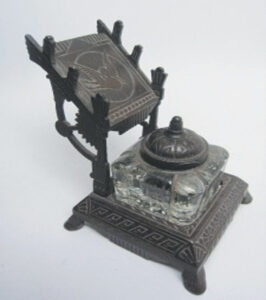
Q. I found this ugly metal and glass inkwell while cleaning out a desk drawer in an old office building. The building was going to be demolished and this had been my late fathers office for many years. I had planned to throw it away but decided to find out if it was anything special. The bottom of the pressed glass inkwell shows “PS& W Co.” Pat. Date Dec. 11,77. Top of metal part shows stork and places for four pens. Any value?
T.G. – Ft. Lauderdale, FL.
A. Beauty is in the eye of the beholder. What a find! Your desk inkstand was made in 1877 by Peck, Stow Wilcox Co., Connecticut. At that time many such desk inkwells were of cast iron in a variety of designs. Silver, as well as other materials, were popular. The fancier ones were status symbols. A good examples would be inkstands and entire desk stands made by Tiffany & Co.
A collector might pay $400 or more for yours.
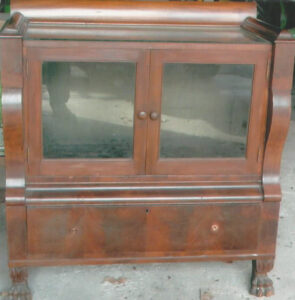 Q. I retrieved this cabinet from an 1800s farm house and have had it for several years. I’ve asked people what they thought about it and they had no answers.
It is 42” wide, 44”high and 22” deep with a glass see-through top, double glass doors and a bottom drawer. The sides are padded horse hair canvas as is the back. What is it? What was it used for, how old and any value?
B.G.S.- Goshen, Indiana
A. You have a rare example of American Empire furniture(1820-40). The finish appears to be mahogany veneer. The use of horsehair padding on the sides and backs is confusing. It could have been used to protect the sides. Since the drawer pulls are missing this lowers the value. However, a collector of Empire furniture might pay $800 or more.
Q. According to our family history this beautiful side chair belonged to our great grandmother and sat in her parlor. That would have been sometime in the mid 19th century. It was supposedly brought from England when she came to America around 1860. It now belongs to me.
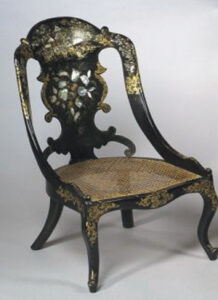 It is in perfect condition and a friend told me it is made of papier-mâché with a lacquer finish. It has mother-of-pearl inlays. On the bottom is a worn stamp that looks like “Jennens and Bettridge.
What can you tell me about it and what could it be worth.
A.G.S. Kansas City, KS
A. You have a piece of English furniture making history. Aaron Jennens and T.H. Bettridge, in Birmingham, England, began around 1815 creating Oriental style, papier-mâché furniture and decorative objects very fashionable at the time. They pioneered a process combining mother-of-pearl inlays, gilding and hand painting.
It all began when the Japanese began trade with Europe and America in the 1850s and when Japanese pieces were exhibited at the London International Exhibition in 1862. Jennens and Bettridge exhibited their pieces and won awards.
Your chair could have a current auction value of $700 in America, much more in England.







Follow Us