
 By Roy Nun
The world’s favorite married couple, Blondie and Dagwood, have been living in our neighborhood for over 70 years now. Chic Young’s seemingly immortal “Blondie,“ whose continued appearance in over 2,000 newspapers around the world makes it the most popular comic strip of all time, was first seen on September 15, 1930. Appearing in the dailies and Sunday funnies ever since, the Bumsteads quickly came to be loved by Americans as if they were next-door neighbors.
Young did not invent the family theme comic strip, but he certainly perfected it. In the many years since, “Blondie” has had dozens of imitators but no equals. It also substantially influenced radio and television situation-comedy shows.
The comic strip, however, did not begin as a family affair. Originally, it was the adventures of a charming and lovely, though penniless, socialite flapper who rarely played with a full deck. Blondie Boopadoop (yes, that was her real name), always surrounded by admiring men, was constantly pursued by a dogged and determine millionaire’s son, Dagwood Bumstead. But Dagwood didn’t have a ghost of a chance until Young, sensing a change in the mood of the country caused by the worsening economic depression altered course in mid-stream.
On February 17, 1933, Blondie and Dagwood were married in the very first wedding ever to occur in the funny papers. Blondie shed her Roaring ‘20s look to be come a feminine, level-headed housewife and mother of the new era. Dagwood’s family disinherited him, and he found himself a working man – for the cranky and grouchy Mr. Dithers.
The following years saw the birth of Baby Dumpling, who later became Alexander, and seven years later, a daughter, Cookie, came along. The Bumsteads were now a standard, typical, middle class – though not too typical – which the reading public could so easily identify with.
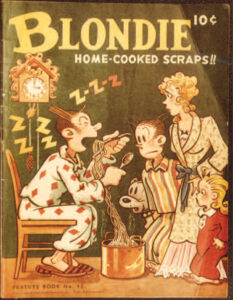 The comic strip was a never-ending chronicle of Dagwood’s attempts to triumph over life’s constant small adversities of job and marriage. He wins a few, just enough to whet the appetites of sympathetic male readers, but most times he comes up short.
Dagwood is a kind-hearted, sincere and loyal husband, father and employee, who is also a bumbling, though well-intentioned, incompetent, constantly getting himself into trouble. Blondie, the real brains of the family, is forever rescuing him – or finding him out.
Chic Young continued to do “Blondie” until his death in 1973. At that time, his son, Dean, and Jim Raymond, both long-time assistants to Young took over the strip and maintained the same style and flavor. From all indications, the changeover has had no effect on the strip’s widespread acceptance.
In 1938, when the cartoon was still not quite a decade old, Columbia studios made its first Blondie movie, aptly titled “Blondie.” Penny Singleton and veteran actor Arthur Lake, forever fixed afterward in the public’s mind as Blondie and Dagwood, were the stars.
In all, the duo starred in 29 Blondie films for Columbia. They were produced on the average of one every six months, the last being “Blondie’s Hero” in 1950. These movies, though definitely “B” grade, were hits with generations of moviegoers and later with television viewers. Today the avid collector can find one-sheet posters, lobby cards, and black-and-white promotional stills from all of them.
 Arthur Lake and Penny Singleton took their roles to radio for a successful 11-year run under the sponsorship of, first, Camel Cigarettes and later, Super Suds. Arthur Lake, with Pamela Britton playing Blondie, reprised his role as Dagwood for NBC on television shortly after New Year’s Day in 1957. But this first of two attempts lasted only a few months. Likewise, in 1968, a new “Blondie,“ with Will Hutchins and Patricia Hartly heading the cast, managed to survive the ratings wars for less than six months.
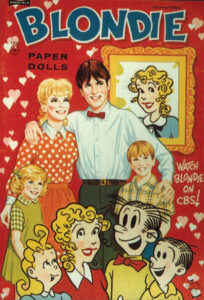
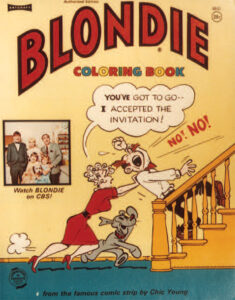
Except for a paper doll booklet, with illustrations of the show’s stars, and a couple of coloring books – all by Saalfield, few collectibles can be found about this final try for a broadcast winner.
The success and popularity of “Blondie” gave birth to a considerable amount of memorabilia and souvenirs over the years. All of them are now in demand by collectors and nostalgia buffs.
Included are many paper doll booklets, the first by Whitman in 1940; and dozens of coloring books – also originated by Whitman in 1940. Other publishers of similar novelty books were Saalfield, Lowe, and Artcraft. The Bumstead family also appeared as paper dolls in newspapers during the 1930s.
Beginning in 1938 several publishing houses produced numerous comic books. Most were monthly or semi-monthly issues. Everyone, even “Daisy and Her Pups” (six of them on an irregular basis between 1951 and 1955) headlined a comic book series.
In the late 1930s hardcover and softcover books, aimed at children of all ages, poured off of the presses. These related the comedic mishaps of Blondie, Dagwood, and their kids and pets.
Blondie From A to Z (David McKay Co., 1945), for example, was an A-B-C book for very young readers. On the other hand, Blondie’s Cookbook (David McKay Co., 1947) was targeted toward older children, since it blended together, ever so nicely, recipes and small-sized cartoons.
The famous Big Little Books series from Whitman boasted of at least 14 different Blondie releases. All were done in comic book style. Blondie and Baby Dumpling kicked of the series in 1937 and Blondie – Fun for All finished it in 1949.
So popular were the Bumsteads during the last six decades, thanks to radio, the movies and the comic strip itself, that Blondie and hubby Dagwood became American pop-art heroes. They and their children showed up on everything imaginable, from Dixie cup lids and Pep Cereal pins in the 1940s to all sorts of greeting cards. Mechanical valentines featuring them began appearing shortly after World War II and are highly prized today.
Toys, particularly Marx Company’s “Dagwood’s Aeroplane” (1935) and “Blondie’s Jalopy” (1940s) wind-up mechanicals; paint sets of the 1940s and ‘50s; board games; playing cards; and cloth dolls by Columbia Toy Products Co. in the 1950s are just a few of the many treasures once sold about America’s favorite cartoon family that are now eagerly sought by collectors.
Dagwood and Blondie, in the tradition of comic strips and their heroes and heroines, never grow old. They are as youthful and fresh today as they were more than 70 years ago. True. Alexander and Cookie have grown up, but even so, it took more than a half-century for them to become teenagers.
But the Bumsteads have kept up to date. Blondie is much more the liberated woman nowadays. In fact, a few years ago she went to work running her own catering service. And Dagwood, for a short while, quit his job with Mr. Dithers to work with her.
Thanks to Dagwood, Blondie, and the rest of the family; all of their neighbors; friends; co-workers; and boss Mr. Dithers, we have had over seven decades of wonderful memories, novelties and toys to collect.









Follow Us